by Chris Harris
It’s at times like this that most organisations gravitate towards the easiest solution, and for Denham Phoenix FC the easiest solution was obvious. They could simply bring Hilario Vincent back.
The logic was straightforward enough. Yes, he had been sacked for stealing from the football club, which was not normally considered an ideal qualification for future employment. However, unlike many disgraced managers, Vincent had not disappeared elsewhere in search of another opportunity. In fact, as far as anyone could tell, he had not even attempted to find another job. That left him in a peculiar position. The board knew exactly where he was, he remained familiar with the club and, perhaps most importantly, they had quietly agreed amongst themselves some time ago that if Guy Stevens, or indeed any future manager failed, Vincent would always remain available as a fallback option.
It was all too easy to ignore whatever his faults were, but he had done an excellent job on the pitch. The uncomfortable truth remained that the board now found itself contemplating the possibility of replacing a successful, ethical and thoroughly decent man with somebody who had been caught stealing from the club.
The situation forced Greg to confront a growing list of decisions that seemed, with hindsight, increasingly questionable. His stance over the Pear Tree Farm field combined with the increasingly painful realisation that he had badly misjudged the Heaven is a Percolator contract and Catherine Brown fiasco. Was he losing his touch, was he going to mess up again?
By the time the directors assembled for the emergency board meeting, it became clear there were no easy answers at the moment. Opinion remained sharply divided. Some directors were adamantly opposed to any suggestion of Vincent returning, others took a more pragmatic view, reasoning that football clubs are ultimately judged by results and that Vincent had consistently delivered those results while in charge. After all, they knew his weakness now and would be more vigilant.
Among the most vocal opponents was Big Mal who regarded the entire discussion as an insult. More than anyone else, he had clashed with Vincent over the theft as they had previously been friends and Mal felt violated by his actions. In his view, somebody who had betrayed the trust placed in him had forfeited any right to a second chance.
It was Christmas. Every director had commitments beyond football. Families needed attention, businesses needed running and social calendars were already overflowing. The prospect of advertising the position, reviewing applications, conducting interviews and navigating weeks of uncertainty held little appeal for anyone around the table. The club needed stability and it needed it quickly.
Daen’s position, meanwhile, was refreshingly straightforward. He had absolutely no desire to become interim manager for any longer than was strictly necessary.
Although happy to step in temporarily as circumstances required it, he regarded the idea of taking the role permanently as unrealistic. He lacked managerial experience, had spent only a short period coaching and was already heavily involved in other aspects of the club. Asking him to take charge indefinitely would be unfair both on him and on the team.
The following morning, acting on behalf of both the board and Guy Stevens, Dean released an official statement confirming the manager’s departure.
Guy’s message struck exactly the tone supporters would have expected. He spoke warmly of the football club, thanked the directors for their support and expressed his gratitude to the supporters who had embraced him during his time at the Phoenix. He described the opportunity at Maidstone United as a once-in-a-lifetime chance and explained that, after considerable thought, he felt compelled to accept it. He wished Dean every success for the upcoming fixtures and expressed confidence that the club would continue progressing long after his departure.
The reaction was surprisingly subdued. Perhaps because so many supporters were relatively new to the club, there was little sense of collective mourning. Most fans understood the attraction of a move several divisions higher and accepted Guy’s explanation, even if they did so reluctantly. Within a few days attention had shifted away from the departing manager and towards the question everyone really cared about. What happened next?
Dean, whose social media presence was normally a constant stream of optimism, predictions and enthusiasm, suddenly became noticeably quieter. Having watched recent events unfold, he seemed reluctant to tempt fate. His caution proved entirely justified.
The Phoenix travelled to Gravesend & Northfleet and were comprehensively beaten 4-0.
With Dean unable to interview himself after the match, Catherine Brown stepped in to conduct the post-match interview. Dean admitted that Guy Stevens’ departure had left a considerable void within the dressing room and suggested that the players were still adjusting to the sudden change. The performance had been disappointing, but not entirely unexpected. In reality it had been a disaster. Dean may be a great communicator as an influencer, but in the dressing room he seemed to lack the necessary tools.
The board reconvened on Monday evening, this time meeting discreetly at Greg’s house rather than their usual venue. Negotiations with Hilario Vincent had stalled immediately. He knew he had a strong hand and wanted the board to agree to announce that he had left not under questionable circumstances, but because he felt he was underpaid, while omitting the fact that he made up the shortfall by stealing his perceived shortfall in his wages. It was sour. Not a single director particularly wanted another recruitment process either.
Everyone understood that advertising the position elsewhere would almost certainly provoke Vincent into becoming even more difficult. Discussions would drag on, costs would increase and the entire affair would become increasingly public. Reluctantly, the board continued exploring the possibility of bringing him back.
Behind the scenes, however, Dean had begun quietly speaking to contacts across non-league football, discreet conversations designed to establish whether any suitable candidates might exist. The situation deteriorated further the following Saturday.
The Phoenix lost 2-0 at home to East Grinstead, a side sitting second from bottom of the table.
The performance raised alarm bells. Concentration levels were poor, confidence appeared fragile and it was becoming increasingly obvious that Dean was not ready for management. He had spent barely four months as a coach before finding himself unexpectedly responsible for a promotion-chasing football club. It was too much, too soon.
Vincent, meanwhile, had attended both matches. Part of him was undoubtedly enjoying the situation. Every defeat increased the pressure on the directors and strengthened his negotiating position. Every dropped point made him appear more valuable. Every poor performance gave him the chance to ask for a little more.
Yet even he recognised there were limits. Should the club’s decline become too dramatic, there was a danger that blame would spread beyond the boardroom and onto him. His reputation had already suffered considerably, and another public controversy could leave him effectively unemployable within non-league football.
To Greg, the more he thought about it, the clearer the solution became. They should tell Vincent to get knotted and advertise the position. Dean was pressuring for a resolution and they had three big games over the Christmas period.
Unable to run his business properly as his focus had shifted to temporary management, which he was no good at, he sought help from the most logical of places. Piotr had been brilliant working with the under-18s and women’s team; maybe he could bring some necessary impetus.
Piotr had remained quiet about his previous involvement in football. Everyone at the club recognised that he had some talent and that he had played in the Ukrainian leagues. He was exceptionally fit for his age and seemed to possess a depth of football knowledge that went far beyond what most people would expect. His coaching sessions with the under-18s and the women’s team were well organised, professional and clearly effective, but few people knew the full extent of his background.
In reality, Piotr had come through Dynamo Kyiv’s youth system before forging a respectable professional career with Zorya Luhansk in the Ukrainian Premier League. Although he never reached the international level, he was a highly regarded professional and enjoyed a successful career in the top flight of Ukrainian football. By the age of thirty, before the outbreak of the war, he had already completed and passed his coaching qualifications and had begun thinking seriously about his future beyond playing.
Moving to England had not been a decision he took lightly. For several years he had maintained an on-and-off relationship with an English woman, with each visiting the other every few months. It had never been a conventional relationship, but it had endured. However, when his nephew was killed during the war, Piotr found himself struggling to cope with both the personal loss and the wider situation unfolding around him. Eventually, he decided to leave Ukraine and move to England.
The move did not bring the fresh start he had hoped for. He arrived carrying a considerable amount of trauma and grief, and it was not long before the relationship began to unravel. Within a relatively short period of time, the relationship had ended and Piotr found himself living in his van in the Denham Phoenix car park.
Despite his circumstances, he quickly became a valued member of the club. His work around the ground was excellent, and his involvement with the under-18s and women’s teams did not go unnoticed. He brought an air of professionalism, organisation and football intelligence that elevated both groups. Players responded well to him.
Piotr had long wanted to become more involved with the football side of the club, particularly with the first team. At the same time, he understood that he was walking something of a tightrope. He had comfortable accommodation in the clubhouse, a full-time role helping with the developments around the ground, and the ability to send money back to family members at home. He loved his coaching responsibilities and had developed genuine affection for the people around the football club. The last thing he wanted was to upset the equilibrium he had found.
Yet one of the qualities that had made him successful as a footballer was his competitive edge. As problems at the club mounted and football matters grew increasingly complicated, he found it difficult to remain on the sidelines. So, when Dean asked whether he could help out a little more with the coaching, Piotr’s instinct was immediate. He wanted to get involved.
Over the previous three months, Piotr had gradually built strong relationships with many of the first-team players and, with the club’s form continuing to deteriorate and confidence visibly ebbing away, he persuaded them to attend an additional training session without payment or obligation so that he and Dean could spend some time working on the problems that had begun to overwhelm the side. Curious about what was taking place, several of the directors wandered down to the training ground to watch and were immediately struck not only by Piotr’s continued ability at the age of thirty-three, but also by the effect he appeared to have on those around him. His touch remained assured, his passing precise and intelligent, and he seemed capable of seeing opportunities before anyone else on the pitch had recognised them.
More importantly, however, the atmosphere within the squad began to change over the course of the evening. The players had arrived carrying the weight of recent defeats, with frustration evident in their body language and confidence at a low ebb, but as the session progressed, they became more relaxed and communicative, encouraging one another, discussing ideas, and gradually rediscovering a sense of collective purpose that had been absent for several weeks.
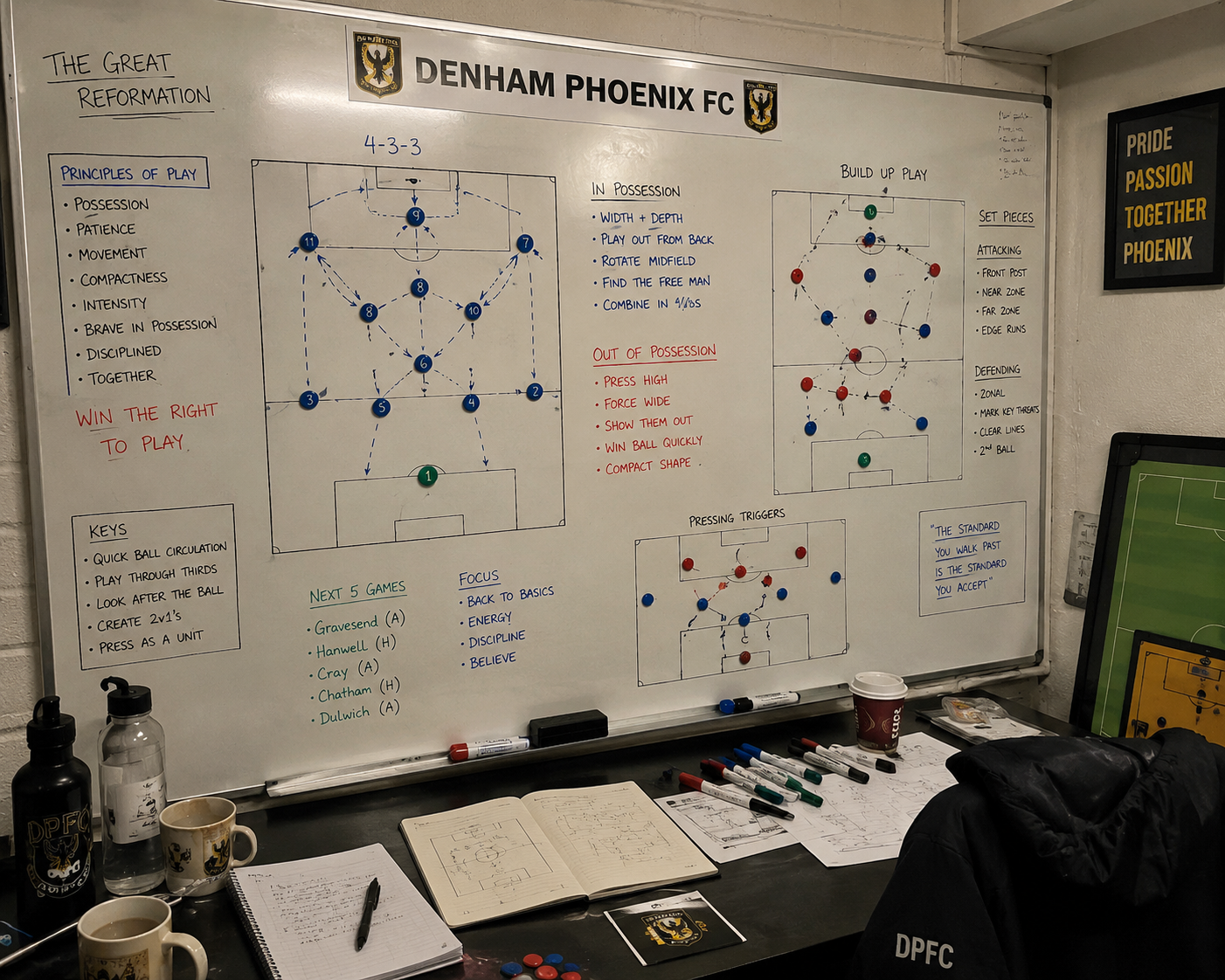
Long after the players had departed and the clubhouse had emptied, Piotr and Dean remained behind, talking through tactical approaches, analysing weaknesses and discussing how the team might be reshaped for the remainder of the season. They stayed until almost midnight, covering whiteboards with formations, notes and diagrams as they worked through possibilities for what they half-jokingly referred to as a complete rebuilding of the side.
The following morning Catherine Brown arrived early to find the evidence of their efforts still covering the tactical board, with arrows, formations and annotations filling almost every available space, and although nothing had yet changed on the pitch there was a growing sense throughout the club that some direction had finally returned. Attention now turned to the forthcoming match against Chesham, a fixture that many regarded as critical. The possibility of three consecutive defeats had created growing concern among supporters and directors alike, and there was a widely held belief that another loss would make it difficult to resist calls to appoint Hilario Vincent, despite the increasingly demanding terms he had sought in previous discussions. The significance of the occasion was understood by everyone connected with the club.
Despite the pressure, there was a surprisingly positive atmosphere around the ground on the day of the match. Although the village and Lewes itself were beginning to settle into the quiet period before Christmas, a healthy crowd gathered, drawn by a mixture of curiosity and cautious optimism. The biggest surprise came when Piotr named himself as player-coach and took his place in midfield, where he immediately began to influence the flow of the game. While his vision and technical ability were often ahead of those around him, occasionally resulting in passes that teammates were slow to anticipate, his presence brought a level of organisation and calm that had been missing from recent games. Throughout the match he remained vocal and encouraging, offering support after mistakes and recognition for positive play, and gradually the confidence that had been absent for months began to reappear across the team.
As the game developed, the improvement became increasingly evident. The Phoenix played with greater composure and purpose, creating chances through movement and possession rather than relying on the more cautious and reactive approach that had characterised much of the previous regime. Four goals were scored, two from Piotr’s pinpoint strikes from outside the eighteen-yard box into the top corners and two created by Piotr’s intelligent passing, while Chesham managed only a single reply. The final score of 4-1 represented an important victory, but it was the nature of the performance that generated the greatest optimism. Supporters left discussing the quality of the new football, the team’s movement, and the possibilities that might lie ahead rather than simply the result itself, sensing that the club had taken an important step forward.
Not everyone, however, viewed events with the same enthusiasm. Watching from a distance, Hilario Vincent could see that the circumstances which had seemed to favour his appointment only a week earlier were beginning to change rapidly, and as the match progressed and the Phoenix’s superiority became increasingly apparent, he realised that the opportunity he had expected might be slipping away.
The buzz in the non-league press when Piotr’s previous career was revealed was enormous. Dean persuaded him it would come out at some point so better he managed it. The big question was: what would now happen to the management set-up? Both Dean and Piotr continued to express reticence about taking on the roles, but Piotr was more than happy to join the ranks of the first team.
But Greg knew it was Hilario Vincent or persuading Dean and Piotr to conquer their misgivings. Both worked for the club for free because of their love and commitment to it and the family of Denham Phoenix FC. More importantly, if he could get this major obstacle off his plate before Christmas, he could focus on mending relations with Catherine Brown and begin working on a solution for the Pear Tree Farm field.
#Non League #Lewes FC #Denham Phoenix FC #Football Story #Football Series

 Welcome to Denham nr Lewes