by Chris Harris
A last-minute house clearance, a difficult daughter and a painting nobody had noticed. What Duncan Drew finds behind a toilet door turns an ordinary Friday morning into something nobody involved will forget.
For house clearance operative Duncan Drew, dealing with Amy Powell had been a thoroughly miserable experience. She had contacted him in a panic two days ago. The sale of the house her recently departed father had lived in was due to complete on Friday 27th April, and it was still full of furniture and effects, a neglect not out of keeping with her historical daughter duties.
Amy was someone who always left everything to the last minute and was surprised when she asked three clearance firms on the Monday morning before to quote, all of whom wanted to charge between two and three thousand pounds to clear it all out, on account of the fact that the contents were pretty much worthless; it was more shelves full of Reader’s Digest magazines and plywood utility furniture rather than antiques and collectables.
It was a last minute recommendation that she contact Duncan Drew. She was delighted she did, as he was only going to charge a thousand pounds. As he said, there were a couple of quality Ercol pieces and a decent dinner service he could sell on to make it worth his while and keep the cost of the clearance down. Duncan was someone who would try to maximise the value of the contents of the clearance, rather than simply pay to dispose at local waste sites. It was good for the customer’s conscience and wallet that the effects were being recycled and, with sentimental value attached, great that these family items were going to a new home.
But Amy didn’t quite see it that way. Inexplicably, despite his quote being dramatically lower, she began to fear there might be other valuable goods; it had never occurred to her before that there might be things of value in the house, but there again she’d have to visit occasionally to work that out. For the next two days she pestered him, trying to renege on the deal after checking the value of the pieces online, arguing he could get a couple of thousand pounds for them. He argued with her that he couldn’t; he would end up having to sell them at auction at a lower trade price and after commissions he’d probably only see a few hundred quid. After a fourth call, he threatened to withdraw his services if she didn’t stop her redeliberation.
On the Friday he turned up with his large Luton and his stepson for the clearance and was utterly hacked off to find within the house Julian Forbes, the local auctioneer, Mary Banshott, the lady from next door, and Scott Sanders, a jewellery expert as well as a stressed Amy. He had a feeling in his water that morning this was all going to be a very difficult procedure.
He immediately said to Amy, “You need to get these people out of here. You’re paying me to do this clearance, and as such all the contents are mine.” Julian Forbes was embarrassed to be dragged into her subterfuge and apologised to Duncan, whom he often did business with.
But Amy started arguing the toss. Mary Banshott, the neighbour, was getting involved too, supporting Amy and berating Duncan for not letting Stanley’s daughter realise top money for the contents she had shown no interest in for the six months since her father’s death.
Duncan reiterated it was an arranged deal and one hundred per cent perfectly legal. Julian backed him up, and a miffed Scott Sanders told her the jewellery was all worthless, forty or fifty quid’s worth of silver and she had wasted his time.
Duncan and his stepson began to remove the furniture, both Scott and Julian anxious to get away but caught up in the fevered deliberations of the contents and how unfair it all was.
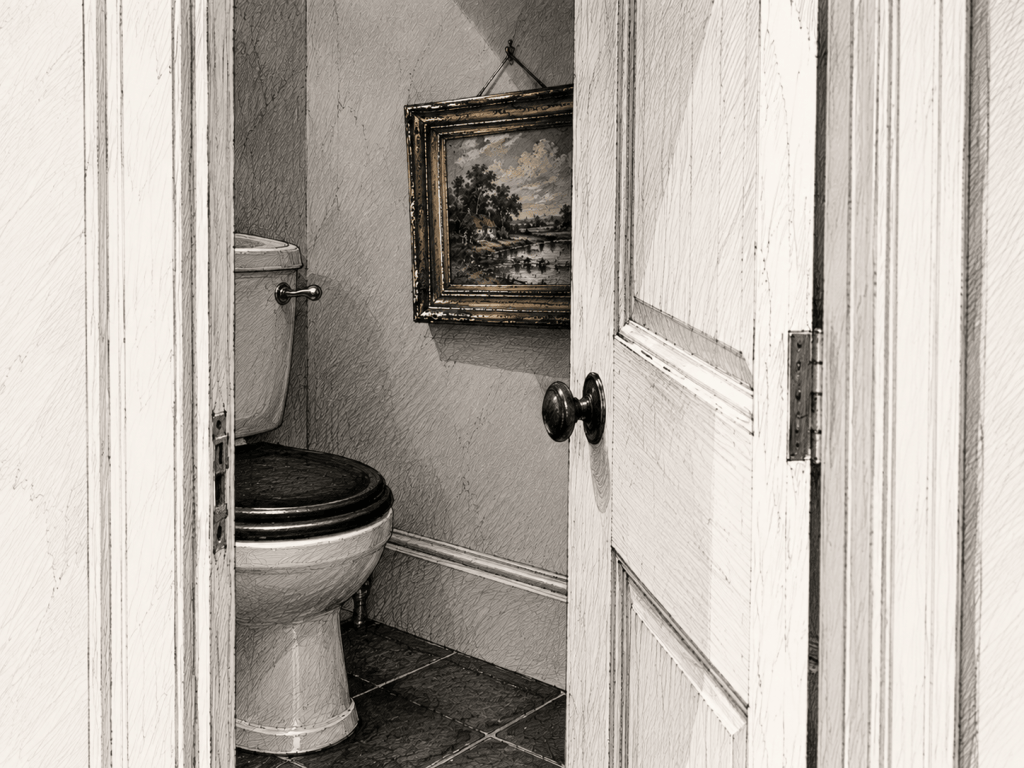
Whilst they were in the kitchen, Duncan called them all back in. He’d found an oil painting just inside the downstairs toilet door he’d not seen when he quoted for the job as it had been hidden behind the door. It appeared to have a faint signature by J. Con. Maybe this was a Constable, he thought. Maybe this was worth an absolute bomb.
It was a muddy riverbank with a cottage to the side and a heavy sky. He’d already put it into ChatGPT to see if it recognised anything, and it had come back saying it was an original oil painting. But while the J. Con looked like part of Constable’s proper signature, lots of artists at the time used to do that, signing it J. Con to try to sell their paintings by association.
But he’d had Amy up to his neck and put the picture on the table. “Crikey, maybe this is a Constable.” He was determined to wind her up and exact some form of revenge as his stepson began boxing up Stanley’s effects.
But Mary, Amy, Julian, and Scott felt the excitement spread through them all, and a nasty bidding war for the picture began. Julian could not be certain of the provenance; an expert would need to verify the signature. It was a high-quality painting, and the condition was poor, but he was happy to offer Duncan £5,000 on the spot.
Duncan was shocked; it was only a wind-up.
“That’s mine!” Amy exclaimed when she heard the offer, trying to grab the picture.
Mary Banshott intercepted Amy, “Your father always promised me this painting; it’s mine.”
“Bullshit did he; he didn’t even like you!” Amy exploded back.
“That’s rich, his own daughter. You never did a thing for him; you think he liked you?”
Scott, enjoying the fracas but anxious to secure a deal himself, chimed in, I’ll give you £7,500. He didn’t know much about oil paintings, but he’d been in the antiques trade long enough and his instinct was if the auctioneer thought it might be good; it probably was, and as a Constable it would be worth maybe £25-30,000, despite its diminutive size and poor condition.
“I’m calling my solicitor,” Amy screamed; her fury grew.
“You do that, I’ll put it in the van for now,” Duncan smirked, knowing he’d got a financial win and his own back on a dreadful customer, and no solicitor in the land would deny the agreement as she had paid him in advance with no claims on items or paperwork. He and his stepson continued to clear the house; Amy sat in her car on the phone, her body language going from feisty to defeated over her solicitor’s deliberations, as Mary stood on her doorstep ranting down her phone about the injustice of it all to somebody.
After a while, Julian reconvened the bidding in the front garden “Obviously we’ve got no proof this was by Constable, so I’m taking a punt; I’ll up my offer to £10,000.”
“Eleven,” Scott snapped back.
“Fifteen, final bid.” A force of habit as Julian turned from Auctioneer to buyer.
As he did so, a siren sounded as a police car arrived. A concerned neighbour could see the situation turning violent. Julian knew the officer. “It’s all fine, Terry, just a misunderstanding.”
Amy had hung up and angrily instructed Duncan to leave the key in the key safe before driving off, in tears over the £15,000 sale. “Rot in hell, the lot of you.” It was as if her father’s much-loved home, both of whom she had neglected, had simply belched her out with a final rebuke.
The money was transferred, and as Duncan left, he stuck two fingers up at Mary. This nearly gave him as much satisfaction as the money!.
Duncan was a happy go lucky chap, so when the picture turned out to be authentic and Julian sold it in a speciality Sotheby’s painting auction for £216,000, he wasn’t bothered about Julian’s luck: “You took a gamble, mate,” and was chuffed when Julian gifted him £5,000 of his own windfall.
The painting was small and in bad condition; otherwise it would have been a lot more, auctioneers’ tip: do not hang Constable’s behind doors in damp toilets for four decades. It wasn’t a particularly good example of a classic Constable, but it was certainly by him, one hundred per cent; and as such, it didn’t realise an absolutely phenomenal seven-figure price, but it represented a phenomenal success for Julian Forbes.
Duncan considered the whole escapade an absolute hoot, and to make the whole experience a meteoric victory, he contacted Amy. Within seconds she was ranting down the phone at him, screaming when he told her of the two hundred and sixteen thousand pounds she had missed out on.
Make both our days by buying a copy of my book!
Something About England: Amazon.co.uk: Harris, Christopher, Turner, Louise: 9798174255661: Books
Welcome to Denham, a fictitious Sussex village where behind respectable doors, well-tended gardens and familiar faces, things have a habit of going badly wrong.
Obsession, ambition, deception, jealousy and petty rivalry run through this collection of tragi-comical and satirical short stories. From poltergeists and lottery winners to cricket club feuds and environmental disasters, ordinary people embark on discovering just how quickly an ordinary life can unravel into an extraordinary mess.
Darkly funny, occasionally poignant and populated by characters who are rarely quite what they seem, these stories explore the peculiarities of Middle England, and the uncomfortable territory between respectability and ruin.


