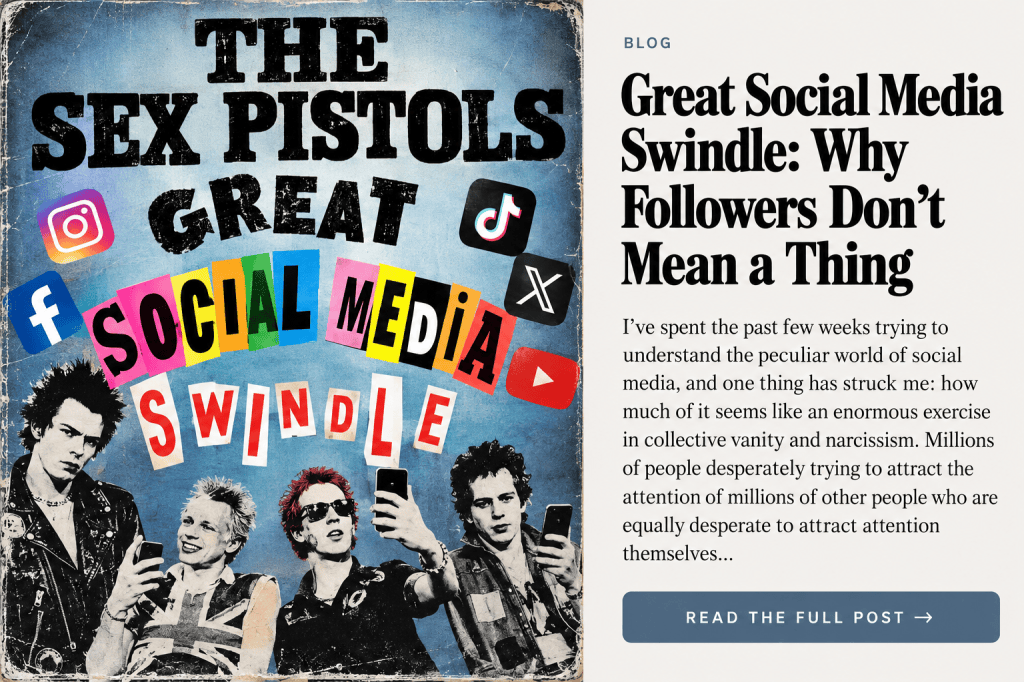
by Chris Harris
Social media has become an extraordinary exercise in vanity, with millions chasing followers who have little interest in what they do. Is 10,000 meaningless followers really better than 500 genuine readers? My thoughts on the great social media swindle.
I’ve spent the past few weeks trying to understand the peculiar world of social media, and one thing that has struck me is how much of it seems like an enormous exercise in collective vanity and narcissism. Millions of people desperately trying to attract the attention of millions of other people who are equally desperate to attract attention themselves. An extraordinary ecosystem in which everyone wants an audience, but relatively few seem particularly interested in being one. Everyone seems to be wannabe Influencers, but footballers all want to be in the Premier League; only maybe one in fifty thousand will do so.
An enormous amount of it is, frankly, banal shite. People post things of no conceivable interest, others respond with equally meaningless comments, and endless invitations to follow, like, share, and subscribe. Of course, some genuinely excellent material is in there; I mean, look at mine! But waiting for it to drop on your screen amongst all the tosh is the reason I stopped using it for a long time, and I am back using it for my book with strict parameters not to get dragged into the pitfalls of the medium.
The Follower Obsession
Perhaps the strangest aspect is the obsession with follower numbers. People follow complete strangers in the hope they’ll reciprocate, join groups devoted to exchanging followers, or even pay businesses to manufacture the appearance of popularity. People use elaborate strategies to follow hundreds of accounts and then quietly unfollow anyone who doesn’t return the favour. All this activity is presumably intended to make someone appear more successful, interesting, or influential than they actually are. You see someone; they have ten thousand followers, but there are hardly any likes or comments. They have paid for friends and followers- suckers sucked into the addiction of following the algorithm, wanting to look popular, but actually just look sad to me.
I mean what does having 10,000 followers mean if hardly any of them are interested in what you do? Suppose you’re a writer, musician, artist or small business owner, and you’ve managed to attract 1,000 people who genuinely appreciate your work. These are people who have discovered you, enjoyed something and decided they’d like to see more. Now imagine that you spend the next few months relentlessly chasing followers until the total reaches 10,000, but the additional 9,000 have little or no interest in your work.
Congratulations. You’ve increased your follower count by 900%, but you haven’t necessarily acquired a single additional customer, reader or genuine admirer.
The Mathematics of Meaningless Popularity
Let’s assume that 100 of your original 1,000 followers regularly engage with your material. That’s 10% of your audience. Now add 9,000 uninterested followers, and those same 100 people represent just 1% of your impressive new following. Your engagement rate has collapsed, even though the number of people genuinely interested in you hasn’t changed at all.
Naturally, real life isn’t quite this tidy. Some followers acquired through networking may eventually become interested, and social media algorithms don’t distribute posts equally. But the fundamental point remains. If the additional followers never read, watch, click, visit or buy anything, the practical benefit is negligible. In some cases, a large, indifferent audience can make it harder to tell what’s genuinely successful, and accounts can start to look spammy.
Yet people devote extraordinary amounts of time to acquiring these numbers, poring over spreadsheets as they try to buck the system. They celebrate arbitrary milestones, congratulate one another on their achievements, and proudly announce they’ve accumulated another thousand followers. But followers aren’t customers, and likes don’t prove loyalty. A stranger tapping a heart beneath a photograph doesn’t necessarily express meaningful interest in the person who posted it.
Popularity Versus Interest
Of course, there is nothing wrong with wanting a larger audience. For anybody producing something worthwhile, reaching more people is a perfectly sensible ambition. Nor is there anything wrong with advertising to people who might genuinely appreciate what you offer. The distinction is between attracting an interested audience and simply accumulating names.
For a writer, 500 people who regularly read new stories are infinitely more valuable than 20,000 who couldn’t name a single thing the writer has published. Over the next year, I’m aiming for 500 good followers over the 5 social media and 4 publishing platforms that represent my original hub for promoting my stories and book. I don’t want 20,000 who won’t even remember my name or read any of my stories. The same principle applies to musicians, artists, independent retailers, and almost anyone trying to turn creativity into a living. The objective should surely be to find people who care about what you do, rather than persuade people who don’t care to follow you anyway.
Perhaps the most extraordinary thing about social media is that it has turned the appearance of popularity into an achievement in its own right. Somewhere along the way, the number became more important than what the number was supposed to represent.
I have no objection to people wanting to be popular. But surely it’s more satisfying to be popular with people who are actually interested and focus on creating better content than chasing numbers. Otherwise, what’s the point?


