by Chris Harris
A Facebook Marketplace furniture sale turns into a nightmare when a charming buyer claims woodworm. Isaac discovers a scam far bigger than he imagined.
Isaac and Rosie had no children, so they doted on their younger brother’s two children, Zach and Nicholas. It was a crushing blow when, two years ago, Nicholas committed suicide while at university.
It began the decline of Isaac’s relationship with his brother, whom he had warned for years about Nicholas’s addiction to his mobile phone and social media, which his brother had always played down. Even when Nicholas was on antidepressants and clearly struggling with his degree, Isaac would go down to Exeter to visit him, to check he was all right. His brother just thought he was a fool playing up to him, until Nicholas hanged himself.
His brother blamed his son’s penchant for alcohol and soft drugs, and the mixing of these with antidepressants, for his death, absolving himself of neglecting to deal with the root cause of it, which Isaac believed was the glaring harm that social media had caused him.
Over the two years since the death, Isaac had been unable to come to terms with it, and the pair took the decision that, with no real family between them in the UK, they could fast-forward their dream of moving to France.
Isaac had been in ethical finance, and Rosie a teacher; the dream was to move to France, buy a smallholding with a barn, set up a Brocante for both of them (they spent hours a week trawling the internet for all of the antique programmes, blogs and videos), and become self-sufficient in food and live off the land.
They found a place in Normandy near Alençon that, because it was in a relatively remote area, though on a busy road for the potential business, was very cheap. So they could buy that and a small house to keep in the UK.
They weren’t going to take their furniture down with them. They wanted to buy rustic, vintage French country furniture to furnish the house and move their existing furniture into the smaller UK house, leaving a dozen pieces behind. None of them was particularly special, mostly mid-century and well-made pine.
They considered donating it to a charity shop and having them pick it up, but reasoned they could get 500 quid by flogging it on Facebook Marketplace.
One of the things they planned to do when they moved to France was to give up social media entirely in homage to Nicholas. So this would be the last throw of the die.
They’d bought and sold on Facebook Marketplace before, so knew it was a pain in the arse. It was free to use because it let Facebook raise money without any real administration; it was a platform for private negotiation and, as such, a place to see the full cross-section of good and bad human behaviour.
Facebook Marketplace customers are divided into four. Thirty per cent are just normal; they see something, contact you, arrange to collect and pay you. Perfect. The next thirty per cent are a tad scatterbrained and disorganised but mean well; they mess you about a bit, but they have no agenda other than to pay you what you want and collect the item; they just make it bloody hard work. Then the larger thirty-nine point five per cent. They use the relaxed format of negotiation and non-commitment to paying in advance as a tool for hard-nosed further negotiation and exploitation: they agree to buy, but are clearly still looking for something even cheaper elsewhere; they draw you into the sale and generally renege on arrangements, and then simply don’t turn up to collect, citing the old chestnut, “I had to go to the hospital,” or “my car broke down.” Facebook Marketplace users are the unhealthiest and hospital-prone people in Britain, with the most unreliable cars. Then there is the one per cent, the complete shit.
Isaac had been lucky so far; he’d put relatively high prices on, so there was wiggle room to negotiate, but nobody had, so they’d realised seven hundred pounds, some potential messing about from customers, but at the slightest whiff of this he would say he had other interest, which knocked the time wasters into shape sharply.
The buyer clicks a button and it sends an automatic message over to the seller: Is this available?
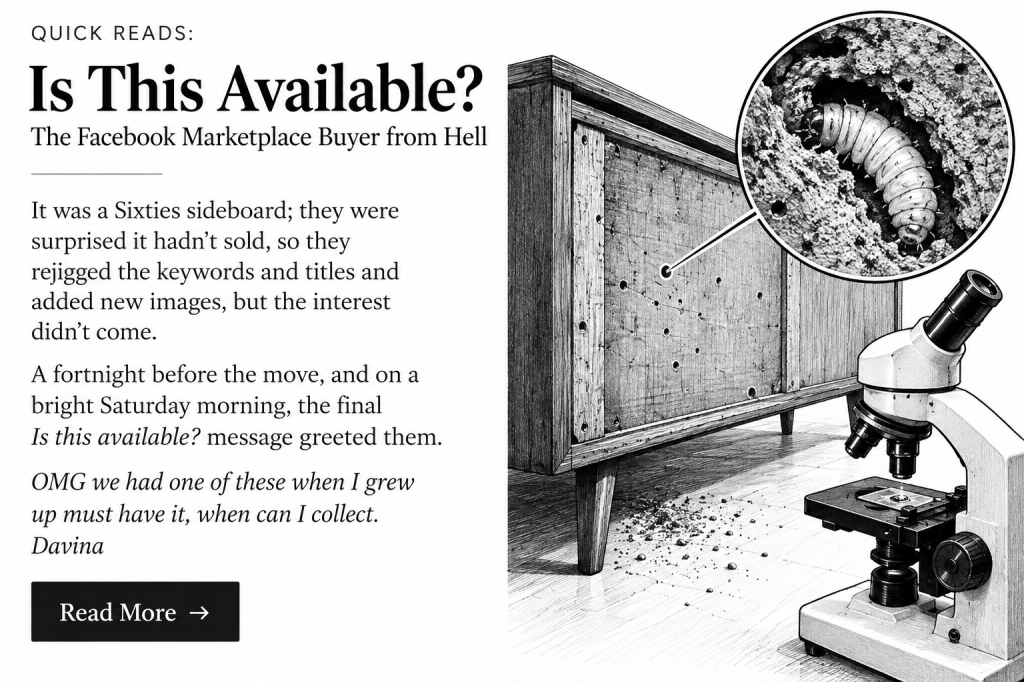
It was a Sixties sideboard; they were surprised it hadn’t sold, so they rejigged the keywords and titles and added new images, but the interest didn’t come. The charity warehouses all said it wasn’t worth the trip to pick up one piece, so if it wasn’t as good as they thought, they might have to smash it up and take it to the tip. They’d had the piece for twenty years, so they were loath to do so. It was a fortnight before the move, and on a bright Saturday morning, when the final Is this available? message greeted them.
OMG, we had one of these when I grew up. Must have it. When can I collect? Davina
We are moving in a week, so the next seven days, but sooner the better; really needs to be this weekend.
He pinged the message over and automatically regretted putting an obstacle in the way.
I’ll see if I can borrow a van; would Monday be okay?
He felt relieved his amateur subterfuge had not put her off.
I grew up with one just like this; can’t wait to get it!
“Ah, that’s sweet,” Rosie commented. Over morning coffee, they discussed how fitting it was that the last piece was going to such a perfect home, where it would be cherished and mean so much to someone.
Isaac would later reflect on his almost childlike and naive anticipation of the sale going through to the perfect person and the sales tally going up to £800, such had been the delightful exchange of messages with Davina.
She loaded his sideboard into the van. What struck him was that, after hiring the van, she’d already picked up three more large pieces of furniture. He invited her in for coffee before they both said their kind farewells.
She couldn’t have been at home for more than half an hour before he received the message:
Oh, Isaac, you’ve really let me down. The back’s got really bad woodworm. Oh, I’m so upset. I’m going to have to pay someone to replace this. Can I have my money back? It’ll cost me at least £100 to get that sorted. I should have checked it, stupid me, but it’s worthless with the worm and I don’t want my house infested. Obvs you can come and pick it up if you want to sell it again.
They sat down, almost slightly shocked. To be fair, it had been sitting against the wall for 20 years and there may well be some in the back.
Sorry, we didn’t notice any; perhaps you could send us a photo?
There wasn’t a huge infestation, but there was enough evidence, and the close-up photo she took showed dust coming from some of the holes, which meant it was live.
Oh my God, I’m so sorry. Look, we’ll get back to you in the next couple of hours. We’ll just go and suss out what to do.
Okay, hun,
They went onto Google to check up on woodworm, and it confirmed it would be live. They’d always been members of the local Lewes Facebook group, so they went there for advice, assuming the easiest thing to do would be to refund her. Six people who took the time to reply affirmed their thoughts. It was just a refund; it didn’t matter; it was their fault.
They thanked everybody to close the conversation, when something else came on.
Did you have woodworm in any of the other furniture? You said you sold the lot.
They thought about it; they hadn’t noticed any and nobody had mentioned anything.
Is there any woodworm on the skirting board? You say there was dust. Go and check to see if there’s any evidence of any dust still on the floorboards.
None
Mate, I think you’re being scammed. Go on some of the Sussex vintage groups on Facebook. You might find some answers.
They had a couple of weeks before they moved, and they were organised people. If they had to go the next day, they could. With time to spare, they joined the Facebook groups, smelling a rat.
It was the Vintage Home Facebook group in Bexhill where they got the answer they were looking for.
Oh, I had something like that from someone called Rosemary, a nice woman, about 50, slightly plump, long blond hair in a hire van. She said there was worm. I was sure there was not and refused, but she said that she’d sue me if I didn’t refund her. She said she’d already had the backboard replaced because she didn’t want the worm to spread straight away.
It was confirmed. They got back to Davina:
Of course we’ll send you the money back. But before you do, before we do, can you please just send us a photo of the entire back of it?
Now they had a rough idea of what a scam was, they noted that the actual woodworm on the plywood backing only showed the plywood backing, and you couldn’t actually make out if it was actually from their piece of furniture.
No, you don’t need to see that. Just send me the money back. I don’t know why you’re being so difficult.
Normally Isaac was the sort of person who wouldn’t like to offend anyone, but now that he was being scammed, he decided to play it cute, but did not feel any reticence about playing her for the right result.
Well, of course I need to see it. How do I know it’s actually from my piece of furniture?
He knew she’d never been expecting that. Their exchanges and their meeting had been nothing but pleasant, but now he was calling into question her integrity. Then she did exactly what the man from Bexhill said she would.
You don’t send me the money now, I’m going to take you to court, the small claims court. And you’ll be paying court fees on top. I thought you were both so nice, how wrong I was.
Along with their new confidant from Bexhill, Neil, they’d been researching all of the local vintage and furniture Facebook groups. They put the call out asking if anyone had fallen for the woodworm scam, and they received a deluge of replies. She always used the proven technique: a different name, and always threatened them with court. What a crook.
It turned out that at least three-quarters of the people who initially refused to give the money back argued the toss until she threatened to take them to court. This had been her cunning scam. She went around picking up retro furniture priced between fifty and two hundred pounds, then told people when she got it home that it had woodworm and threatened them with the small claims court if they didn’t refund her. It was clever, very clever.
Everyone said the same thing. They didn’t think she had a leg to stand on in court, but they didn’t want to go through all that aggro for a hundred and fifty quid.
Isaac, Neil and two others formed a WhatsApp group. The other three had all sold furniture to her and refunded her within the previous three weeks. They shared their photographs and began searching all the selling platforms to see if they could find their furniture for sale to trace her business: Etsy, Vinterior, eBay, Antiques at Home, Retro Market, and others. But to no avail.
As a last-minute idea, Isaac suggested they simply start looking on Google to see what came up.
It looked like it would be a monotonous task, going through tens of thousands of Google images and what seemed like half a million references, but it turned out to be surprisingly easy. What she couldn’t conceal was that she had her own website, which kept her away from the established vintage selling platforms.
It was a really smart website, called Mid-Century Retro Furniture Finds. She was asking ridiculous money for the furniture, but evidently doing quite well, judging by the number of sold items still appearing on the site. Unfortunately for her, the greed in her huge profits, which she obviously poured a lot back into marketing, meant her site featured high up in the Google rankings when you searched for retro furniture.
With the website identified, and having worked in financial services, Isaac began to pull in a few favours. He knew the easiest and quickest way to harm the crooked trader, whose real name turned out to be Claire Rushton, was to get her payment service provider to launch a fraud investigation.
His old work colleague told him to gather as much evidence as he could, and then the four of them in the WhatsApp group went into overdrive, searching as many sites as they could and posting appeals for anyone ripped off by Claire Rushton to come forward.
Claire Rushton, of course, saw many of these posts and forwarded some really nasty personal threats to Isaac, followed by threats of legal action. He didn’t even bother contacting his solicitor. He knew there was no basis for defamation because everything they were saying was supported by evidence.
His friend created a form for him to send to the victims of Claire Rushton’s subterfuge, and within twenty-four hours they received responses from forty-five people who had been ripped off.
Given how quickly they’d pulled everything together, they could reasonably assume there were many more victims, which they mentioned in the covering letter accompanying the evidence.
The payment service provider immediately froze her merchant account and launched a fraud investigation. At the same time, to prevent her from jumping ship, the provider referred the case to an industry fraud-monitoring system used by other payment companies to identify potentially fraudulent merchants, so she would be unable to trade and would be blacklisted.
Unable to trade through her website, all Claire could do was send a solicitor’s letter threatening to sue Isaac for £50,000 for loss of business and damage to her reputation.
He didn’t even bother replying through a solicitor. He simply sent a message himself.
I await seeing you in court.
At the same time, the four of them had been swamping vintage furniture sites and Facebook groups with photographs of Claire Rushton taken from her website, warning people under no circumstances to deal with her. If she turned up to collect furniture, they warned, they could expect her to demand their money back pronto.
It was the evening before Isaac and Rosie were due to leave for France. He’d already messaged everyone on WhatsApp to thank them for all their help. They sat around a makeshift table with a couple of bottles of wine and a takeaway, everything else having been packed for the move.
They’d already closed all their social media accounts except Facebook, and as they started the second bottle of wine, they both ceremoniously put their fingers on the button to finally close the account.
They raised their glasses and said in unison,
“To our darling Nicholas.”
Make both our days by buying a copy of my book!
Something About England: Amazon.co.uk: Harris, Christopher, Turner, Louise: 9798174255661: Books
Welcome to Denham, a fictitious Sussex village where behind respectable doors, well-tended gardens and familiar faces, things have a habit of going badly wrong.
Obsession, ambition, deception, jealousy and petty rivalry run through this collection of tragi-comical and satirical short stories. From poltergeists and lottery winners to cricket club feuds and environmental disasters, ordinary people embark on discovering just how quickly an ordinary life can unravel into an extraordinary mess.
Darkly funny, occasionally poignant and populated by characters who are rarely quite what they seem, these stories explore the peculiarities of Middle England, and the uncomfortable territory between respectability and ruin.


