by Chris Harris
Trevor was the undisputed pub philosopher, holding court with his cronies and declaring himself an expert on everything. But when he unexpectedly falls for Petunia, a mixed-race barmaid, his deeply ingrained prejudices threaten to expose the man behind the bluster.
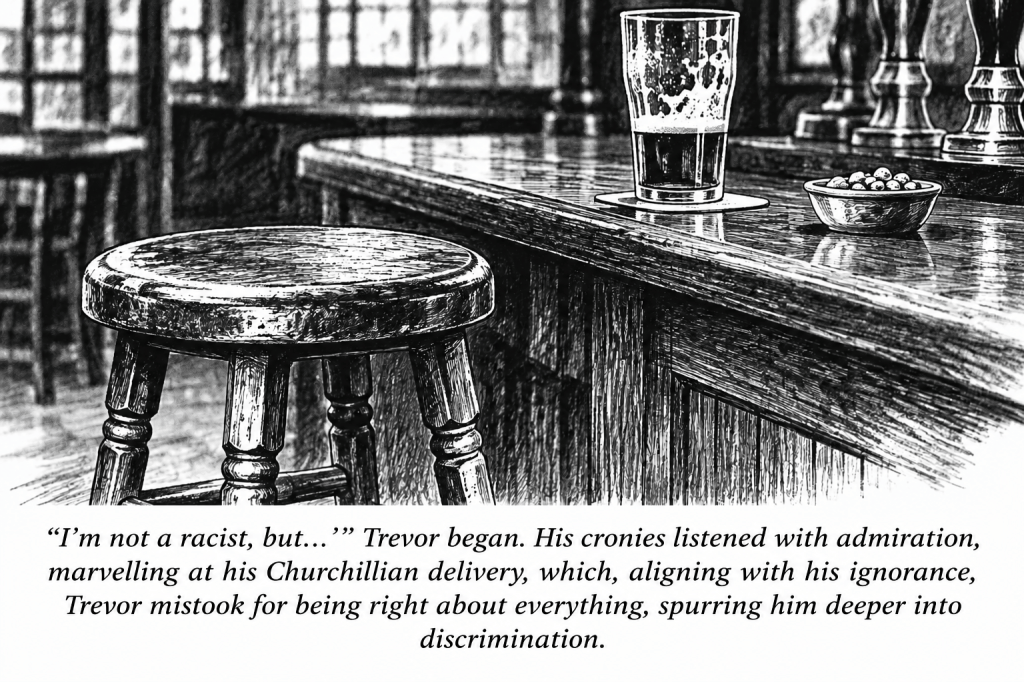
“I’m not a racist, but…” Trevor began his usual address to the gathering of his cronies around his favourite bar stool. The subject was ‘Black Ian’, although Trevor had never wondered why Ian needed identifying by the colour of his skin. Nor had he ever felt the need to explain why he wasn’t racist. As far as Trevor was concerned, declaring himself not to be one absolved him of being one.
He was in his element, on his stool, holding forth on everything wrong with the world, who was responsible, and what ought to be done about it. His opinions were an intoxicating mixture of bigotry and cosy racism, and, of course, whatever was trending on TikTok; hence his preferred subject matter, the evils of immigration. His cronies listened with admiration, marvelling at his Churchillian delivery, which, aligning with his ignorance, Trevor mistook for being right about everything, which spurred him to delve deeper into the gutter of discrimination.
Ian was relatively new to the town. He worked in one of the local restaurants, and on Saturday afternoons he’d go to the King’s Head and try to drink away the memories of being treated like shit by his manager and the head chef in the kitchen where he worked as a kitchen porter.
“I love you people,” he would say to anyone who would engage with him. Generally, anyone he befriended at the bar would listen because he was a lovely, friendly man and very clever. He would begin a conversation with anyone and anybody, a great listener, and after five or ten minutes would tell them how much he loved them. A graceful personality, but a lost soul who everybody knew and liked.
On this particular Saturday afternoon in the King’s Head in Lewes, Trevor sat on his own at the bar, downing the customary pints of Stella, watching Black Ian, assembling his thoughts to preach later to his masses. He walked past Ian, who said, “Hello Trev, I love you, man!”
“Oh, alright, Ian, nice to see you,” before going outside for a fag. It was these afternoons when he would watch Ian and deliberate on whether he was racist or not, and happily reach the conclusion that he wasn’t, even though he was. After the brief exchange of friendliness, he puffed away on his fag and double-decided he most definitely was not racist.
Trevor had been a regular in the King’s Head for twenty years, and as the Stella’s began to accelerate down his neck, his short-term affection for Ian dissipated as the afternoon dragged on, sitting with his pint whilst on the other side of the bar Ian merrily chatted away with everybody. Mind you, he was glad it wasn’t him talking to him but he still felt jealous of Ian’s popularity.
Dead on six, Ian would always leave to go round his sister’s house for dinner, something they did every week. By then, Trev’s mates would be starting to appear, having finished work or returned from football.
Trev would then hold court. A group of eight of them, drawn together by their mutual love of Stella, Sky Sports, talking shit, and womanising. All from the building trade, generally polite and friendly, if somewhat cocky and loud. They were weekend warriors and would leave at ten a.m. and get the train to Brighton for clubbing, fighting and getting laid, in no particular order.
Trevor would not join them; his place of relaxation was the King’s Head, which he frequented every night and where he was surprisingly popular, the lovable rogue. The general ambience was a place of calm, and he respected that, and it was generally him who shooed his friends off when they began to get too loud.
“That Black Ian was in here again. Pissed off his face, annoying the customers. Now, I’m not a racist, but everyone knows black people can’t take their alcohol. So why do they continue serving him?” His mates nodded their heads at his wisdom.
Racism ran through his family. When he was a child in Croydon, his grandfather was always going on about “these bloody niggers ruining the country”, while during his impressionable teens, his parents would complain about “these bloody Muslims and immigrants ruining the country”.
Trevor was once a cowboy builder. Necessity now had him working cash in hand on sites around Lewes for various contractors. His work was good, but when he ran his own business, he bodged everything for a quick buck, so eventually the supply of customers who hadn’t heard of his lazy and cheating work ethic gradually ran out, and he went bust.
He always resented being back on the building sites. As far as Trevor was concerned, these days they were drenched with foreign workers who did have a proper work ethic. He was now expected to put in a hard day’s shift to keep up, or he’d risk losing the work. Going from a few hours bodging and lying a day to eight hours of hard graft was, as far as Trevor was concerned, because of the immigrants. “I’m not a racist, but these immigrants are putting us all out of work.” His mates would ponder why Trevor said what no politicians seemed to say: the truth.
Trevor had always been too selfish and stuck in his ways to be involved in a grown-up relationship. His mates, with partners, would look embarrassed as he would condemn anyone involved in the drudgery of a committed partnership, and even his mates sometimes baulked at his misogyny. He’d skirmished with short-term relationships when he was younger, but now he settled for gratuitous sex with people on the internet; he had his stool at the bar, and meeting women would simply interfere with Trevor’s outlook and way of doing things.
Until Petunia arrived. The new bar person.
Aged thirty, beautiful, charming, kind, well-mannered, absolutely delightful to speak to, and mixed race. Trevor was enthralled by her; none of the other drinkers in the pub could fathom why she seemed so taken with him. It was a slow burner. Trevor knew he needed time to gradually persuade his cronies that nearly everything about her was actually white. She dressed like a white person, she spoke clean English, ate English food during her work breaks. “Come off it,” he’d reason, everything about her was white.
Petunia had put herself through university and had come down to Sussex to study for a master’s degree. As the weeks drifted by, his prejudiced guard began to drop as she flirted with him, and he unwittingly began to fall for her, to the degree that he spent most of his day thinking of her. He wrestled with her colour and his feelings towards her, fought his attraction and enjoyment of her company, but was smitten.
Petunia basically just wanted to have sex and occasional company; she liked a bit of rough and was happy to bypass his lack of intelligence and ignore his bullshit and take him as a lover. Her degree was to take a year, so she had no time for anything more complicated. Trevor, on the other hand, pictured them living together.
Trevor had absolutely no idea how to approach the subject of a date with a non-white woman, not knowing if there was a specific etiquette; his cronies could obviously offer no advice. So, he was completely taken aback when it was Petunia who did the asking.
“Well, maybe that’s just what these people do,” he later confided to his friends, playing the success down, but doing somersaults inside. The date was set for the following Saturday. Or was it a date?
“Let’s just meet in the pub. Nothing serious. Just two mates having a drink,” she said, playing his expectations down.
“Yes, of course, just two mates.” Both were privately imagining something rather more.
During a shift on the Thursday before their date, Petunia spoke to Jenny, another regular at the pub, and told her about Saturday.
“You’re joking, aren’t you? He’s a bloody racist!”
“No, he’s not at all,” Petunia replied, feeling quite insulted, as if she wouldn’t have known. “I’ve spoken to him loads of times. I’ve picked up on absolutely nothing. He’s a lovely man.”
“Well, I tell you what. Like all these people, you just check his socials.”
Petunia felt a twinge of treacherous disgust with herself as she brought up Trevor Wilby’s Lewes Facebook account. Most of it was just about West Ham Football Club, family stuff, photographs with his mates and the usual Facebook trite. A smile swept across Petunia’s face as she went a few months back through Trevor’s Facebook posts, finding absolutely no evidence of racism whatsoever.
Until October 22nd, three months earlier, about the same time she started at the pub, she reflected.
“I’m not a racist, but…” he’d written, before launching into a prejudiced rant about a black person involved in some newsworthy event. Her smile dissolved as she continued scrolling backwards. The further she went, the more his prejudicial, ugly and judgemental nature revealed itself. And it wasn’t just black people. It seemed that anyone who wasn’t white was a legitimate target for his opinions. Nobody, other than Trev’s perfect inhabitants of a perfect world, was spared.
She’d worked incredibly hard to put together the money to take her master’s degree, to the extent that she held down three part-time jobs. She was highly intelligent, educated and independent. So how had she fallen for this bloke? The more she thought about it, the more disgust she felt, more so with herself. She always knew he was charming but a bit dim; how could she have fallen for him?
Trevor was preparing for Saturday evening with a sense of peculiar trepidation. He had a very high opinion of himself, but he was ten years older than her, and he knew he was punching way above his weight; still, he reasoned that her colour changed the dynamics and evened it out. He made a particular effort to look and smell good, cleaned his flat, changed the bedsheets and made sure the condoms were in the bedside drawer, ready for the inevitable conquering of Petunia.
A group of black people sat near the restaurant area. He didn’t think anything of it until one of them waved at him. It was Petunia. He went to the bar. A ping came through on his phone. “You did say we were just meeting as friends, so I’ve brought some of mine along as well. Hope you don’t mind.”
Oh, my fucking Christ, he thought. This is so embarrassing. How has this happened? Had he misread the signs? Do black people take their friends with them on a first date?
The pub was already full of his friends. They, and the other regulars, pretended not to watch him as he bought himself a pint, sensing a car crash. Everyone knew about the date. Trevor did not know whether to buy a big round; he wasn’t tight, but did you do that with black people? They all seemed to be drinking soft drinks. He forced a smile as he approached the table and sat down, feeling everyone glaring at him. He could hear chuckling, or he thought he could, as paranoia swept through him.
He just wanted to get up and leave. But then he’d look exactly what he was. A racist. As her friends nattered, he smiled along. Should he stay or should he go? He certainly wasn’t like his parents or grandparents. They were racists. He wasn’t. The Stella went down at quick speed, and he lightened up and joined in the conversation, which now had turned to Caribbean food. The only contribution he could think of was that he didn’t really understand what Caribbean food was. The conversation moved to music, Caribbean politics; it was almost as if he was being wound up.
Petunia got up and began gathering the drinks orders. “What would you like, Trevor? Your usual?”
“No, no, no, no. I’ve really got to go. Like I say, it was just a meeting of friends. I’m going to shift off home. Nice seeing you, Petunia, and lovely meeting your friends.” He almost whispered this into her ear in embarrassment.
The words had come from nowhere. He hadn’t intended to leave, but once he’d started making his excuses, there was no going back. He felt dizzy with confusion, not wanting to look a twat to his mates, the regulars, or offend Petunia and her friends. He realised he was now engaged in a desperate exercise in damage limitation, trying to extricate himself from the situation without looking like a complete fool.
“Okay, Trevor, we’re going off to the Caribbean night at the Elephant and Castle. Are you sure you don’t want to come?” The voice gave it away; even Trevor picked up that it was not a friendly invite. There was no Caribbean night at the Elephant and Castle, and he had been set up by Petunia.
As he left, he could pinpoint the sudden roar of laughter coming from Petunia’s table, his humiliation complete.
Trevor was a one-pub person. Like everything in his life, it was his way or no way. So he went to the off-licence by the station, bought himself some cans of Stella and headed home. He’d only just started his first can when the texts came through from his mates telling him the offending group had left. He returned to the pub.
He took pride of place at the head of the table his friends were sitting at, eschewing his normal bar stool, and waxed lyrical. He had already racked his brains and come up with the perfect excuse for the debacle, not once considering why what had just happened had, why the woman who had been obsessed with had turned traitor. His cronies fell silent, waiting to hang on to his every word.
“I’m not a racist… but.”
I’m Not a Racist, But… The Popular Phrase of the Pub Philosopher
There are few more ominous ways to begin a sentence in the English language than “I’m not a racist, but…” You know what’s coming, why they bother with the first five words, words designed to establish someone’s innocence, followed by a sixth that demolishes the entire defence.
The but is doing an enormous amount of work. The but introduces the contradiction; the offensive racism follows. The but is invariably a slant on some form of prejudice or racism that the but plays down and softens the racism, in the eyes of the speaker.
We’ve all encountered it. The number of times I have met someone, especially when the guard is down in a pub, at a party, the footie, but even at work or on the bus or train. Someone gets talking to you. They are friendly, they are helping you innocuously pass the day in conversation. But then once they feel they have broken the ice and there is a connection, passing the time of day soon evolves into opinion and thereafter ‘I’m not a racist, but’ comes out. That is when it is time to make the excuses and leave.
Of course, the speaker is utterly convinced that the introductory declaration has somehow protected them from accusations of prejudice, but as it is habitual does not seem to grasp the excuse does not work,
Where Did It Come From?
Unlike many traditional English expressions, there doesn’t appear to be a single identifiable origin for “I’m not a racist, but…”
Nobody seems to have invented it. There was no famous speech, literary masterpiece or television programme that introduced it to the nation. It appears to have evolved naturally as attitudes towards openly expressed racism changed.
As overt racism became increasingly unacceptable in polite society, people who continued to hold prejudiced opinions found themselves needing a way of expressing them without appearing prejudiced. And what better method than simply announcing that they weren’t?
The expression was sufficiently established to become a subject of academic research during the late twentieth century. In 2000, sociologists Eduardo Bonilla-Silva and Tyrone Forman published research examining how white American college students could reject the label of racist while expressing views that reflected racial prejudice.
The researchers were examining something that most regular pubgoers had probably encountered without ever considering it worthy of academic investigation. The remarkable ability of human beings to contradict themselves within a single sentence.
The Wonderful World of the Conversational Disclaimer
Of course, racism doesn’t have a monopoly on this particular linguistic trick. The English language is full of expressions designed to soften the blow of whatever unpleasantness is about to follow.
“I’m not being funny, but…” Almost invariably followed by something that isn’t remotely funny.
“With all due respect…” A useful warning that the speaker is about to demonstrate considerably less respect than the occasion probably warrants.
“No offence, but…” Possibly the most spectacularly unsuccessful disclaimer in everyday conversation. It suggests that the speaker has identified something offensive, decided to say it anyway and transferred responsibility for the consequences to the unfortunate recipient.
“I’m not one to gossip, but…” Usually delivered by someone who has been gossiping enthusiastically for the previous forty-five minutes and has no intention of stopping.
Then there’s my particular favourite. “I’m not being rude, but…” Here it comes….!
These expressions all perform roughly the same function. They attempt to establish the speaker’s good intentions before those intentions are immediately called into question.
But there’s an important difference. Being rude, gossiping or making an inappropriate joke is not equivalent to racism. The consequences of racial prejudice can be considerably more serious. Which makes the casual familiarity of the expression all the more interesting.
The Pub Philosopher
Every pub seems to have had at least one resident authority on absolutely everything. In my story, see link below, I base the Trevor character on a pub philosopher in my local pub in Lewes. Like many a ‘pub philosopher ’, he was quite ignorant but fuelled with alcohol had no filter to contain his prejudice and ignorance.
The economy, immigration, international relations, policing, the National Health Service and the England football team’s tactical shortcomings. Nothing was beyond his expertise.
He had black friends and played football with a lot of black people, he was affable, so he felt that made him immune from being racist. But they were simply regarded as exceptions to his otherwise firmly established opinions, and his friendship with them exempted him from being the racist he was, justifying his use of the phrase. The contradiction never troubled him.
Do People Actually Believe It?
I think this is the most fascinating question. Are people who use the expression always deliberately disguising their prejudices, or do they genuinely believe that they aren’t racist? Presumably, there are examples of both. I’ve never hung around long enough to find out.
You can challenge people, but especially these days with people brainwashed by social media, it is pointless; you just get the denial that they are not racist. You can point out their opinion is factually racist, but let’s be honest for many a racist or closet racist, reasonable dialogue can be challenging.
Some people understand perfectly well that what they’re about to say will be offensive and use the introduction as a convenient defence. Others may genuinely fail to recognise the prejudice in their own opinions. They can condemn racism while simultaneously expressing racist attitudes.
The Six Words That Give the Game Away
What makes this expression so enduring is that it reveals something about the way people think. Most of us want to regard ourselves as decent, fair-minded individuals. Few people enjoy being accused of prejudice. But there’s a considerable difference between believing ourselves to be fair-minded and examining whether our opinions actually support that belief, that’s where the little word but becomes so revealing.
It provides a glimpse of the contradiction between how somebody wishes to be perceived and what they may actually believe. Of course, not every sentence beginning this way is necessarily followed by something racist. Context matters, and the expression can be used ironically or to challenge prejudice itself.
But its reputation is thoroughly established. It’s become one of those rare conversational introductions where the listener can often predict the direction of the argument before the speaker has even begun; as such, the phrase is useful because, even before the but kicks in, you know it is time to get away!
Make both our days by buying a copy of my book!
Something About England: Amazon.co.uk: Harris, Mr Christopher, Turner, Louise: 9798181129351: Books
Welcome to Denham, a fictitious Sussex village where behind respectable doors, well-tended gardens and familiar faces, things have a habit of going badly wrong.
Obsession, ambition, deception, jealousy and petty rivalry run through this collection of tragi-comical and satirical short stories. From poltergeists and lottery winners to cricket club feuds and environmental disasters, ordinary people embark on discovering just how quickly an ordinary life can unravel into an extraordinary mess.
Darkly funny, occasionally poignant and populated by characters who are rarely quite what they seem, these stories explore the peculiarities of Middle England, and the uncomfortable territory between respectability and ruin.


