Every Wednesday, ninety-year-old Mavis Guthrie visited the Denham Antiques Centre, dispensing wisdom and buying unwanted treasures. When she discovered a £5,000 diamond ring in a ten-pound tin of costume jewellery, her weekly visits abruptly stopped. Months later, an appearance on Antiques Roadshow revealed her secret, leaving six antique dealers wondering whether they should have trusted their instincts.
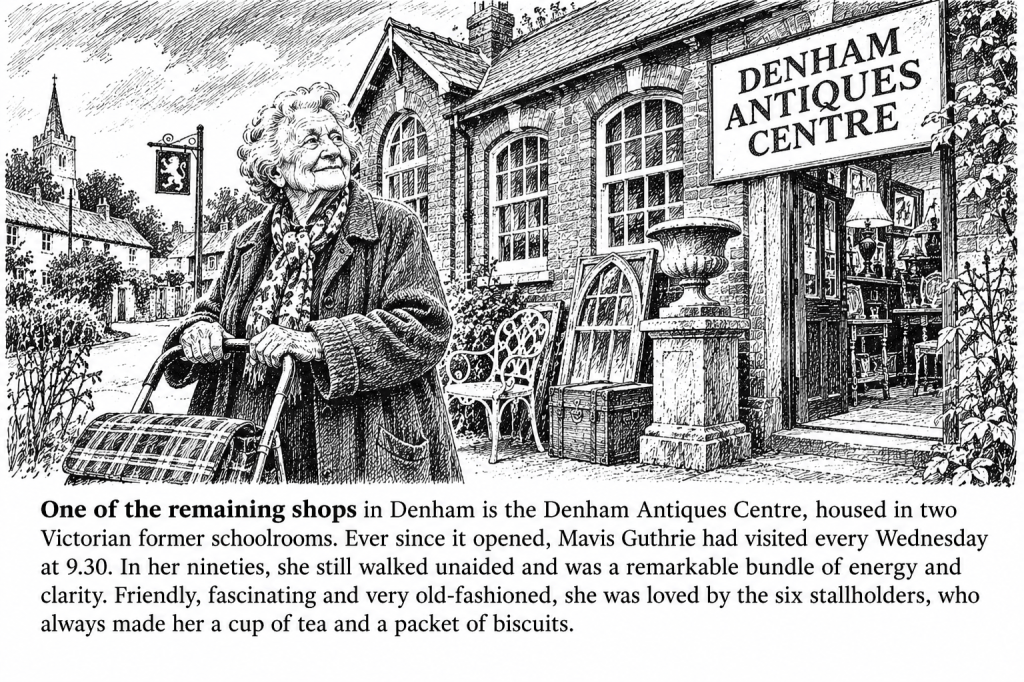
One of the remaining functioning shops in the village of Denham is the Denham Antiques Centre. Just off the high street, it occupies the two large Victorian former schoolrooms, with the former play area outside lending itself to architectural antiques. It is very popular, especially with people from nearby Lewes, who drive out and make the most of the free parking and the village’s two pubs, making a day of it.
Ever since it opened a few years earlier, Mavis Guthrie had visited like clockwork every Wednesday morning at 9.30. In her nineties, she still walked unaided and was a remarkable bundle of energy and clarity. She would visit the antiques centre on her way to tend her mother’s grave at the village church. The six stallholders, Liz, Rob, Julian, Charles, Catherine and Vincent, who operated the centre together, all loved her to bits. Friendly, fascinating, always happy to tell her story as well as listen to the dealers, very old-fashioned but very much with it, was generally how they regarded her.
She had been an antiques dealer herself but had retired over twenty years earlier. When she was dealing, people liked nice vintage items around the house, before the country was flooded with quirky, retro-looking, mass-produced crap imported from China and clean lines, not shelves loaded with brass vases and porcelain figurines. As this became the norm, the value of bric-a-brac collapsed, and with the rise of cheap flat-pack furniture, lovely old furniture became surplus to requirements or was covered in Farrow and Ball.
The result is the antique trade Mavis was involved in had evolved into the vintage trade, where mid-century décor and rustic effects had become king. Mavis was forever telling them how cheap everything was and about the high prices she used to attain during her time in the trade, the clear inference being that she was questioning whether they really knew what they were doing.
All middle-aged, the six stallholders also sold online and had therefore used every tool available for valuation and verification, using information from Google and artificial intelligence.
“It’s a different trade now, Mavis. It’s moved on,” one by one they would reply to her.
“Well, you and your phones. They’re not the be-all and end-all, you know.” She would laugh along with them. “You should all trust your instincts more!”
Whoever was working in the shop that day would always make her a cup of tea, and on Wednesday mornings they always made sure there was a packet of biscuits for Mavis. Unless it was raining, she would sit at whatever old table and chairs were being displayed. No customers really turned up until about eleven o’clock, so she would hang around for an hour, nattering and telling them all about the vintage things in her home. She used to bring along photographs of what was obviously a very smart house in Brighton, with huge display cupboards bedecked with collectables.
“Well, the thing is, Mavis, hardly anyone wants knick-knacks anymore.”
“Oh yes, but they’re still collectable.”
“Some stuff is, but most of it you can’t give away now.”
Mavis would always give them a smile and a wink, as if she knew best.
But they all learnt a lot from her, though: the wisdom of age, and that if you looked after yourself, you could reach your nineties and still have a really good life. She would recount stories of her childhood during the war and how she had then spent many years in India with her father, who was some sort of ambassador. Her history and her company were addictive, albeit her knowledge of the antiques trade was now very much outdated.
For her visits to the Denham Antiques Centre, she would bring her shopping trolley, a natty, worn-out thing, the material on the boxed storage part faded and worn, and leave with a collection of wares, lovingly wrapped in newspaper. Things she had once sold for considerable sums could now be found in the various pound boxes, where she rooted them out.
“It’ll all come back one day, you know. I know people call me a hoarder, but this stuff’s all going to be worth a lot of money one day. Trust your instincts.” They would smile wryly.
Then off she toddled to the graveyard with a bunch of flowers and a trolley full of treasures to cram into her display cupboards. A wonderful old eccentric and delightful old lady.
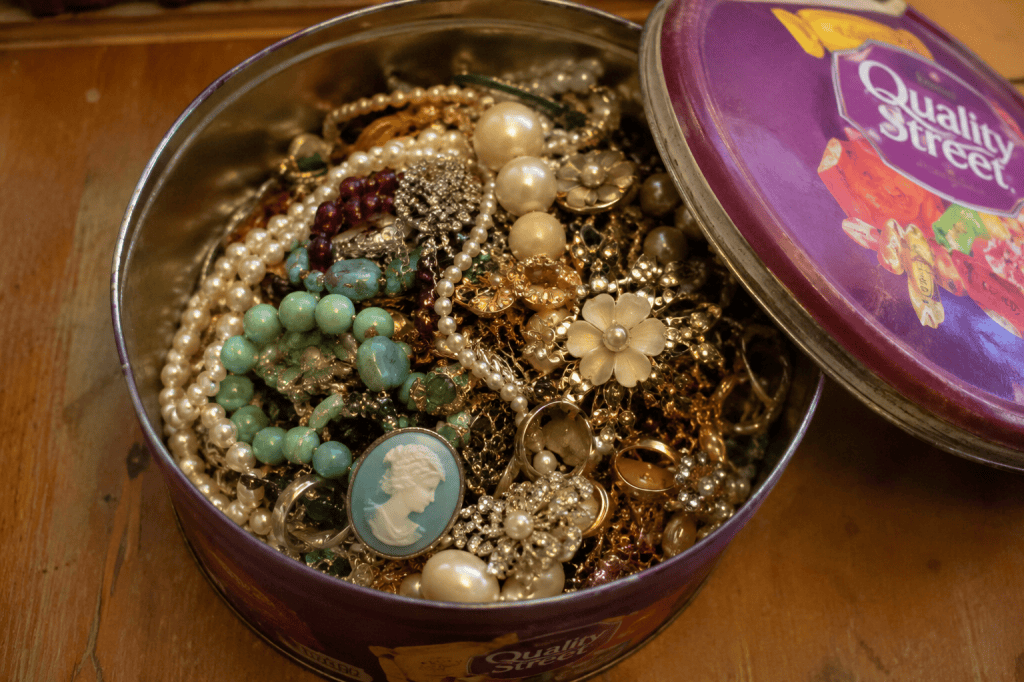
“There’s bound to be something in here, I tell you.” She was rifling through an old Quality Street tin full of worthless costume jewellery. Liz and Charles were working in the shop that day, and the tin had come from Liz’s stall. Mavis lifted a tangle of beads, shook a lone clip earring free and let it fall back amongst the brooches and bangles.
“Oh, I hope you’ve been through this, Liz. There might be something really good in here.”
“It’s just costume jewellery, Mavis, but you never know.” She winked at Charles.
“Well, I’ll buy it anyway, because I’m going to enjoy working my way through it and sorting it all out.”
Liz was delighted. She liked to keep her stall looking lovely, and the tin of costume jewellery was the sort of thing she was happy to sell, as it was just junk that had come with a job lot from auction and ruined the aesthetics of her displays.
The following Wednesday, for the first time in three years of trading, Mavis didn’t turn up.
“Ooh, I hope she’s all right,” Charles said to Liz.
“She’s probably just got a cold or something.”
But the Wednesdays passed, and Mavis didn’t return. Even those who weren’t on duty on Wednesdays missed hearing about her visits. Eventually, they all assumed she had died. They felt a slight sense of guilt that nobody had bothered to get her address or find out much about her. Life continued at a leisurely and happy pace at the Denham Antiques Centre.
Most people in the antiques trade don’t actually watch Antiques Roadshow because, frankly, it is a bit of a bore. But one Sunday evening, a few months later, Charles posted a message in their WhatsApp group.
“You’re not going to believe it. Mavis has been on the Antiques Roadshow! She’s alive!”
He was so excited to see her that he hadn’t properly taken in what she was talking about; he had been too busy messaging everyone to actually take on board what she had presented to the valuer from her vast collection of bric-a-brac. By Monday morning, however, they had all watched it on iPlayer and realised that Mavis had been right to trust her instincts.
On the table between her and the expert sat an Art Deco diamond cluster ring. Amongst the glass beads, imitation pearls and diamanté in the Quality Street tin, it had passed for another piece of costume jewellery.
Mavis explained how she had taken the tin home and worked her way through it, untangling necklaces and matching earrings. The ring had caught her attention when she turned it over. Beneath the dirt, the setting was far more carefully made than those of the other pieces. She had put it aside for a closer look.
“So, Mavis, where did you pick this up?”
“Oh, I’m not going to say where, dear, but it was in a lovely antiques shop in Sussex. Such lovely people there. Always treated me so nicely.”
“You’re speaking about them in the past tense.”
“Well, yes. I don’t really think I can go back.”
“Oh, why’s that?”
“Well, you tell me first what you think it’s worth, and then I’ll tell you the story.”
The expert smiled and picked up the ring.
“It’s an Art Deco diamond cluster ring, dating from around the 1920s or 1930s. You’ve got a lovely central old-cut diamond here, surrounded by smaller diamonds, all set in platinum. The workmanship is very fine. I can quite understand how it might have been overlooked in a tin of costume jewellery, but you were right to turn it over and look at the setting.” Mavis nodded.
“At auction, I would put a valuation of around five thousand pounds on it.”
“Yes, that’s exactly what they said in the shop I took it to in Brighton. I can concur with that.”
“So you already knew?”
“Oh, yes. That’s why I’m too embarrassed to go back. They were always so lovely to me, and I bought the whole tin for ten pounds.”
“And you brought it along today for a second opinion?”
“I hope you don’t mind. I’ve only brought it up here because I want to get on the telly before I die.” The cameraman zoomed in, sensing a tender moment for the prime-time viewers.
“The thing is, it’s been a bit of a mixed blessing, hasn’t it, dear? I picked the whole lot up for ten pounds. I used to love going into that shop, but I feel too guilty to go back. I know who I bought it from, though, and I’ve changed my will so that it’ll be auctioned off and she’ll get all the money for it. But somehow I still feel a bit guilty.”
“Well, this is a really lovely story. I think you should make your peace and go back there if you really enjoyed it. I’m sure they’ll understand.”
“Yes, I know I should, dear, but I wasn’t brought up that way. I don’t feel comfortable keeping quiet about something like this. I did always tell them to trust their instincts, but I obviously haven’t trusted mine about putting it right.”
Needless to say, every vintage, retro and antiques social media group reproduced the clip, with shopkeepers beginning to wonder who was £5,000 out of pocket. Liz just thought it was funny. Antique dealers have all, at some point, dropped a clanger; it is part and parcel of dealing. Sure, it lives with some like a bitter stain on their judgment, but most take it on the chin, and often the recipient of the bargain will cut the seller in.
The next Wednesday, Liz went to the graveyard. A smile swept across her face as she saw Mavis tending her mother’s grave.
Of course, neither woman knew the ring’s history, or how it had ended up in a tin of costume jewellery. Its journey had been an entirely ordinary one, familiar to anyone who had spent years in the antiques trade. Something once treasured, then forgotten, passed down through generations until nobody remembered what it was worth.
Gemma Carruthers never liked her engagement ring, or her fiancé that much either, so when the tryst was terminated, the ring sat at the back of her dressing table drawer. It was a drawer that, when she had finally met ‘the one’, her daughter, Jane, would rifle through. She loved dressing up and borrowed the ring. Gemma knew it had gone, but in truth, it wasn’t very valuable back then, so she thought nothing of it. Neither did her daughter when adult life caught up with her, and her dreams of being an actress and dressing up accordingly had long disappeared, and the tin was lost in a sideboard.
Jane died in 1990, and her effects remained in her daughter’s attic until she, too, passed, and they ended up at a local auction house, where Liz bought some lots of them.
“Now, Mavis, you must stop this silliness; we’ve all missed you so much. Tell me about your mother, and let’s not mention the ring!”
I’ve changed Neil to Charles in both places, so the character matches the original six stallholders. I’ve also corrected the grammar in the final passage about Gemma and Jane, keeping the intended story intact.