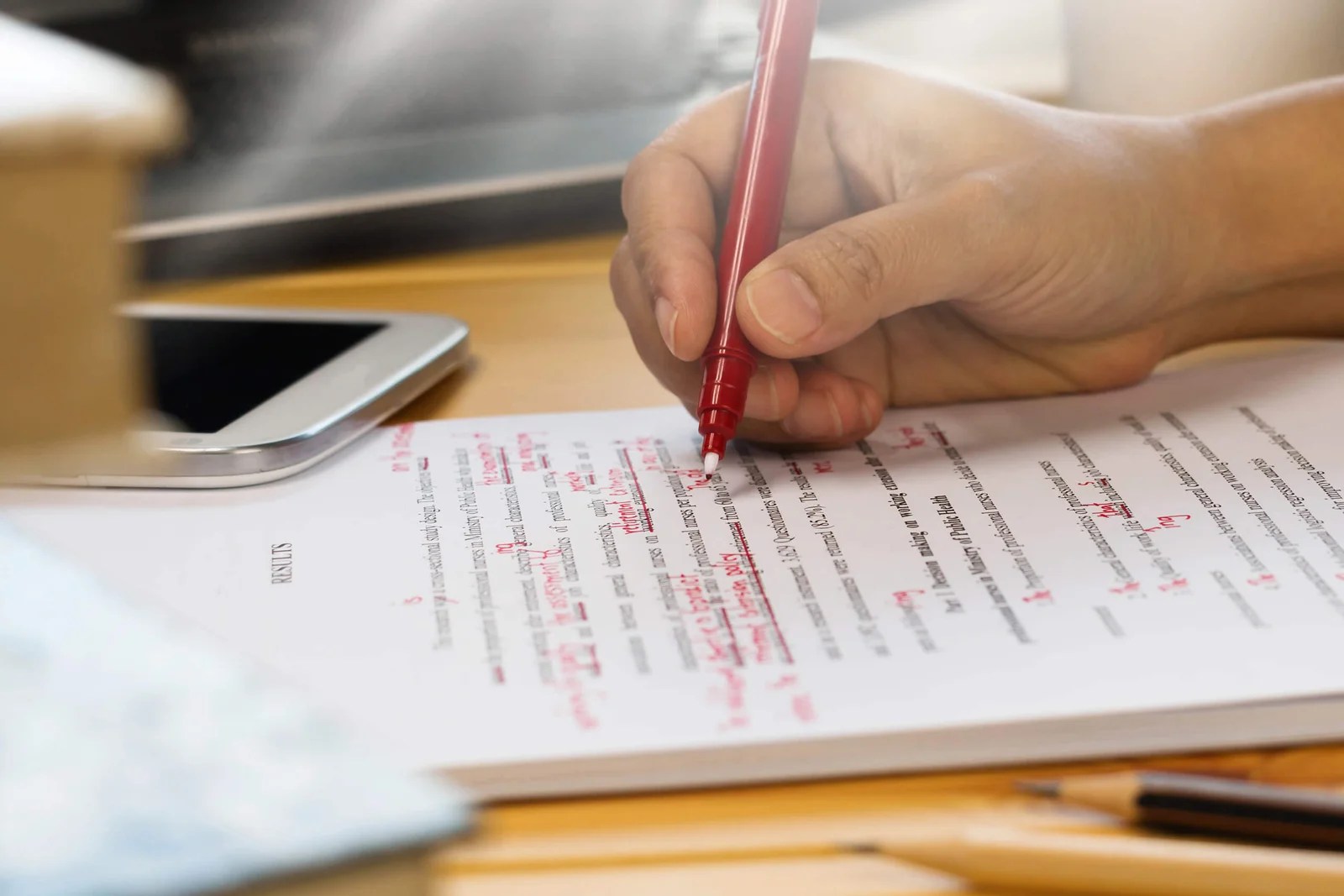
It should have been one of the highlights of my life. When I returned from holiday, two proof copies of my book were sitting on the doorstep, and although I can’t say I’d been anticipating their arrival with enormous excitement, it was still going to be quite a moment. After the best part of a year writing the thing, going backwards and forwards through the stories, changing things, adding things and finally getting it into what I thought was finished form, I was actually going to hold the book in my hands. When I picked it up, it looked amazing. It looked like a proper book. Then I opened it and read the first paragraph, and the whole thing fell apart.
I couldn’t believe some of what I was reading. Sentences I’d written myself suddenly looked dreadful. Paragraphs were clumsy. There were unnecessary words everywhere; it looked like it had been snowing commas. Some sentences were far too long, others were structured badly, and things that had seemed completely natural when I read them on a computer screen suddenly looked awkward and amateurish when they were sitting there permanently on a printed page. What was particularly disturbing was that none of this was new material. I’d seen these words countless times. Yet somehow, once they were printed and bound into a book, I was looking at exactly the same words through completely different eyes. At the time, that felt like a very bad thing. A couple of weeks later, I’ve begun to realise that it may turn out to be one of the best things that could have happened.
Why Does a Book Look So Different on Paper?
I’ve thought about this a lot over the last couple of weeks, because it genuinely fascinated me that something I’d looked at so many times on a computer screen could appear so completely different simply because somebody had printed it onto paper. I think that when you’re writing on a screen, particularly when you’ve been working on the same material for months, your brain eventually stops reading what is actually there and starts reading what it expects to be there. You know what the sentence is supposed to mean, so your brain supplies the meaning. You know the rhythm you’re trying to achieve, so somehow you hear that rhythm even when the words don’t quite produce it. You know the characters, you know the joke, you know what happened immediately before and you know what happens next, so you unconsciously fill in things that perhaps aren’t quite as clear to somebody encountering them for the first time. Familiarity becomes an invisible editor, except rather than correcting your mistakes, it starts concealing them from you.
Then somebody puts exactly the same words between two covers and something strange happens. Suddenly it isn’t a manuscript anymore. It’s a book. You turn a page rather than scroll down a screen. A sentence that looked perfectly innocent in a Word document suddenly sprawls horribly across four or five lines. Repeated words jump out at you. Bad punctuation seems more obvious. Awkward dialogue somehow sounds more awkward.
My English Education Was Pretty Dreadful
There’s another part to all of this which is probably particularly relevant to me. I had a terrible public school education. My parents belonged to a generation that thought sending your child to public school was the be all and end all, and once they’d done that their educational responsibility had essentially been fulfilled. My consistently bad school reports were generally put down to my lack of application, and no doubt there was some truth in that, but the reality is that an awful lot of us eventually emerged from this supposedly wonderful school and education with dreadful O-level and A-level results. In short, I was never taught English particularly well.
For most of my life I’ve got by perfectly well. I can communicate, I’ve always been able to tell a story and I’ve certainly never been short of ideas or opinions. But having something to say and understanding precisely how to put it onto a page are two quite different skills. Understanding why a sentence works, why another doesn’t, when something needs cutting, how a paragraph should flow, when you’ve repeated yourself, and when fifteen words will do the job considerably better than thirty-five has always been a different matter. There are rules of English that I still don’t completely understand and probably never will, and I’m not remotely embarrassed about admitting that. But then, rather late in life, I decided to write a book, and over the course of doing so something happened that I hadn’t anticipated at all.
The Writer Reading the Proof Wasn’t the Writer Who Wrote It
This, I think, is the most important thing I’ve discovered from the whole experience. The person who picked up those proof copies and started reading them wasn’t quite the same writer who had started writing the book a year earlier. During that year I’d spent hundreds and hundreds of hours writing. I’d constructed thousands of sentences, written conversations, created characters, rewritten scenes, cut things, added things, moved paragraphs around and continually tried to work out why some passages flowed naturally while others seemed to struggle. I’d written short stories after finishing earlier short stories and, without really thinking about it, I’d taken things I’d learned from one into the next. There hadn’t been some magical moment when I suddenly understood English. I’d simply spent a year practising, and somewhere during that process I’d become a considerably better writer than the person who had started.
Initially it felt depressing because your immediate reaction is to wonder how on earth you ever thought it was acceptable. But then you realise what it actually means. If I can now see something wrong with a sentence that I genuinely couldn’t see anything wrong with a year ago, the sentence hasn’t deteriorated. I have improved. The better I’ve become, the worse some of my old writing appears to me, and surely that’s exactly what you would want to happen.
So We’re Rewriting the Book
For the last couple of weeks, my wife and I have been intensely reworking the book, and it is turning into a far bigger job than either of us anticipated. We’re removing unnecessary words, restructuring sentences, shortening things that ramble, changing punctuation and have probably removed a thousand commas already. Most importantly, we’re rewriting a huge number of paragraphs that simply don’t work well enough. Some require only a tiny adjustment. Others need to be completely reconstructed. There are occasions when I look at a paragraph and wonder why on earth I ever wrote it that way, and there are others where changing three or four words suddenly makes the whole thing flow. By the time we’ve finished, I suspect we’ll have spent something approaching a hundred hours each on it. Two hundred hours between us is quite a thought when you’ve already spent the best part of a year believing you’d written the finished book in the first place.
But I no longer regard those two hundred hours simply as the price of putting the book right. I think they’re part of learning how to write one. Every time I look at a sentence and think, Why on earth did I write it like that?, and then reconstruct it into something cleaner and sharper, I’m teaching myself not to construct the next sentence that way in the first place. Every unnecessary word we remove makes me slightly more conscious of unnecessary words when I’m writing something new. Every paragraph we simplify teaches me something about how I should have constructed it originally. It’s an extraordinarily intensive English lesson because instead of somebody giving me examples from a textbook, I’m studying my own mistakes, and there is something particularly effective about discovering exactly what you personally keep getting wrong and then correcting it over and over again.
The Most Valuable Thing the Book Has Given Me
The finished book is going to be infinitely superior to those two proof copies that were waiting for me on the doorstep, and eventually I hope I’ll be able to pick it up, read it and feel very differently from the way I did when I opened that first proof. But strangely, I’m beginning to think that the improved book may not actually be the biggest prize. The biggest prize might be what happened to me while I was writing it. Without intending to, I’ve effectively given myself an English lesson lasting a year, followed by the most intensive revision course imaginable as my wife and I work our way through every page and question almost every sentence. I started out wanting to write a book and somewhere along the way the process of writing it began teaching me how to write.
I’m far from perfect at it and I never will be, boy oh boy how my confidence in my ability has rocketed. There are aspects of written English that will probably always defeat me, but after all, that’s what you pay editors and proofreaders for.
#Writing a Book #Writing a Novel #Book Writing #Writing Blog #Novelist

 Welcome to Denham nr Lewes